Video Interview Best Practices for Remote Hiring
Video interview best practices for remote hiring. Learn how to design questions, evaluate candidates efficiently, and avoid common bias with VideoPitcher.
Remote hiring works best when video interviews are structured, short, and easy to review. The strongest workflows ask the same questions to every candidate, keep the first screen concise, and use a rubric so reviewers compare answers consistently instead of relying on memory.
In the rapidly evolving landscape of global talent acquisition, the traditional hiring funnel is undergoing a seismic shift. As remote work becomes the standard rather than the exception, HR leaders and founders are facing a new set of challenges: managing high volumes of applicants from diverse geographies, maintaining a personal touch in a digital-first environment, and ensuring that 'speed to hire' doesn't come at the cost of 'quality of hire.'
This is where video interviews—and specifically asynchronous video assessments—have emerged as a critical tool for success. Video interviews are no longer just a 'nice-to-have' backup for when in-person meetings aren't possible; they are the backbone of a modern, efficient, and inclusive remote hiring strategy. By leveraging video, companies can bridge the gap between a static resume and a face-to-face interaction, gaining deeper insights into a candidate's communication style, problem-solving abilities, and cultural alignment much earlier in the process. If you need category-level context first, review the video screening software pillar guide.
However, simply 'doing' video interviews isn't enough. To truly unlock their potential, organizations must adopt a structured approach that respects the candidate's time, minimizes unconscious bias, and provides hiring managers with actionable data. In this comprehensive guide, we will explore the best practices for video interviews in remote hiring, from designing high-signal questions to implementing efficient evaluation frameworks that scale. Whether you are a startup founder making your first remote hire or an HR leader scaling a global team, these insights will help you build a world-class recruitment engine.
The Strategic Benefits of Video Interviews in Remote Hiring
The shift toward video-first screening isn't just about modernizing the tech stack; it's about solving fundamental inefficiencies in the recruitment process. For most companies, the 'middle of the funnel' is a bottleneck. Recruiters spend hours on 30-minute introductory phone screens, only to find that the majority of candidates are either overqualified, underqualified, or simply a poor cultural fit. Video interviews, particularly asynchronous ones, transform this dynamic. Teams deciding between platforms can compare options in the 2026 buyer comparison guide.
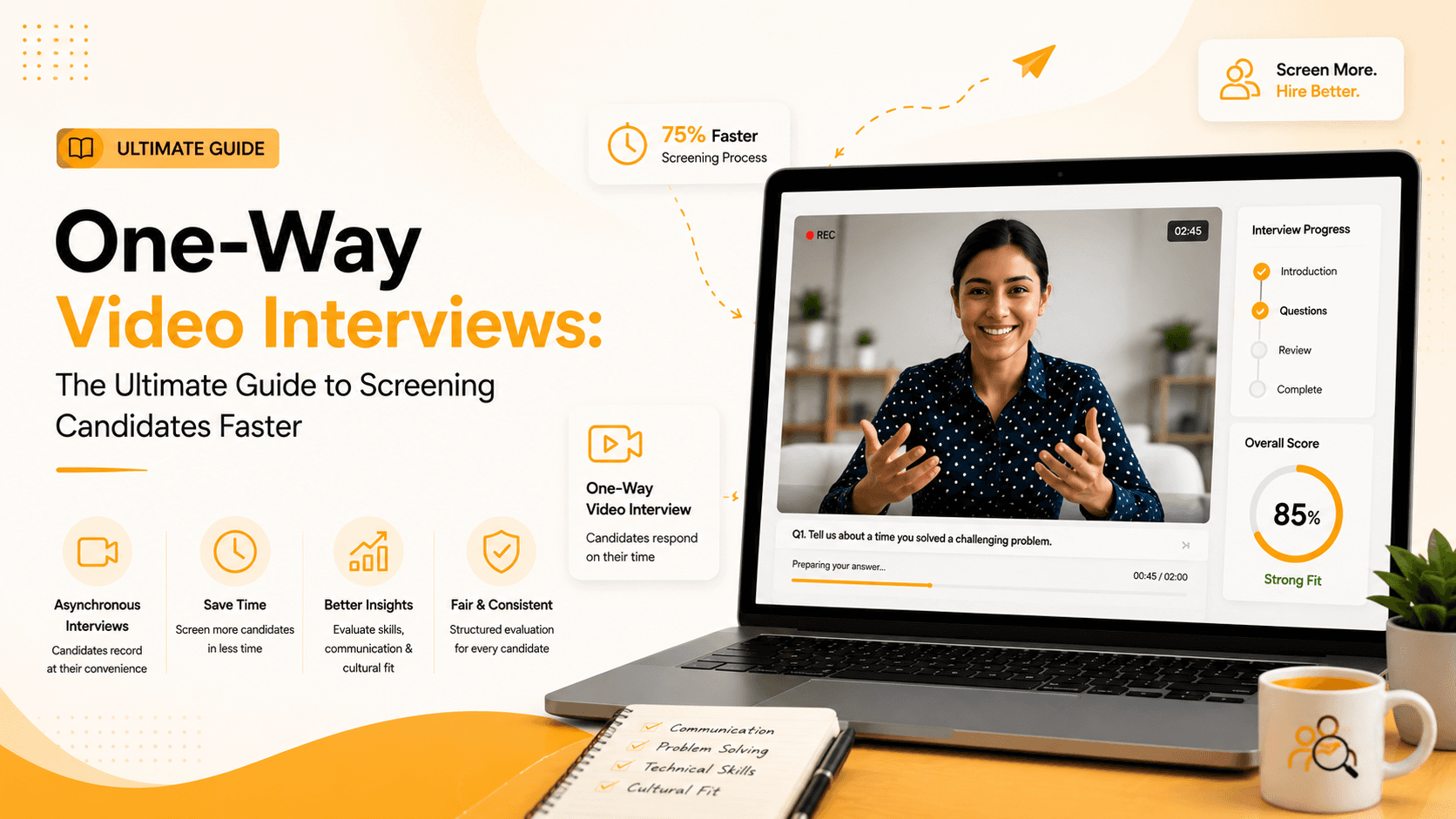
First and foremost, video interviews are an incredible time-saver. By replacing the initial phone screen with a structured video assessment, recruiters can review a candidate's responses in a fraction of the time. While a live call takes 30 minutes (not including scheduling and prep), a reviewer can often evaluate a 3-question video response in under 5 minutes. This allows HR teams to process significantly more candidates without increasing headcount, effectively 'widening' the funnel while maintaining rigor.
Beyond efficiency, there's the critical factor of candidate experience. In a competitive remote job market, top talent values speed and transparency. Asynchronous video interviews allow candidates to respond at their convenience—perhaps after their current workday or over the weekend—removing the scheduling friction that often leads to candidate drop-off. It empowers them to put their best foot forward in a relaxed environment, which is especially important for neurodivergent candidates or those for whom English is a second language and may appreciate the ability to gather their thoughts.
From a cost perspective, the ROI is undeniable. Traditional interviewing involves significant overhead in terms of manager hours and, occasionally, travel expenses. Remote hiring eliminates travel, but the 'manager-hour' cost remains high. By front-loading the evaluation process with video, only the most qualified candidates reach the final, most expensive live interview stages. This ensures that every minute spent by a hiring manager or department head is invested in a high-potential individual, drastically reducing the cost-per-hire.
Best Practices for Designing High-Signal Video Interview Questions
A video interview is only as good as the questions it asks. If your questions are too generic, you'll get generic answers that don't help you make a decision. To design high-signal questions, you must start with the specific competencies required for the role. What are the 'non-negotiables'? What are the behavioral traits that distinguish your top performers? Once you define these, you can craft questions that force candidates to demonstrate those traits rather than just talking about them.
We recommend a mix of three primary question types: Behavioral, Situational, and Technical/Role-Specific. Behavioral questions (e.g., 'Tell me about a time you handled a conflict in a remote team') give you insight into past performance, which is often the best predictor of future behavior. Situational questions (e.g., 'How would you handle a situation where a project deadline is missed by a teammate?') allow you to see their hypothetical problem-solving framework and alignment with company values.
For technical or specialized roles, don't shy away from asking candidates to explain complex concepts. Asking a developer to 'Explain how you would optimize a slow database query' or a sales lead to 'Pitch our product to a difficult stakeholder' provides direct evidence of their core skills. The key is to keep the prompts clear and concise. If a question is too multi-layered, candidates may miss key components in their 60-90 second response window.
Scoring consistency is equally important. For every question you ask, have a 'Success Criteria' or a rubric. What does a 5-star answer look like? What are the red flags to watch for? By defining these beforehand, you ensure that different reviewers are evaluating candidates against the same standard, reducing the 'gut feeling' bias that often plagues unstructured interviews. Remember, the goal of these questions is to provide a consistent, comparable data point for every applicant in your pipeline.
How to Evaluate Video Responses Efficiently and Fairly
Once the video submissions start rolling in, the next challenge is evaluation. Without a system, reviewing videos can become just as time-consuming as live calls. The secret to efficiency is structure. Implementing a standardized rating system—typically a 1 to 5 scale—allows reviewers to quickly capture their impressions and compare candidates side-by-side. Avoid binary 'Yes/No' ratings, as they don't capture the nuance of a candidate's potential.
Collaborative review is a game-changer for remote teams. In a traditional process, the recruiter's notes are the only record of the first call. With video, the hiring manager, the team lead, and even potential peers can watch the same recording and provide independent feedback. This 'multi-perspective' evaluation naturally dilutes individual bias and leads to more robust consensus. It also ensures that the person who will actually be managing the hire has a stake in the selection process from the very beginning.
To maximize speed, encourage reviewers to use playback features. Most video platforms allow for 1.25x or 1.5x speed playback, which is perfect for skimming through longer responses without losing the essence of the communication. Additionally, focus on the 'first-round' goal: you aren't looking for the 'final winner' yet; you are looking to screen out those who clearly don't meet the bar and identify the 'fast-track' candidates who deserve immediate attention.
Fairness must be built into the review framework. It's easy to be swayed by a candidate's background, lighting, or equipment, which can lead to socio-economic bias. Train your reviewers to focus strictly on the content of the answer and the clarity of communication. By using a structured rubric and focusing on job-related competencies, you can ensure that your video evaluation method is a tool for equity rather than an accidental barrier to diversity.
Common Mistakes to Avoid in Remote Video Interviewing
Despite its benefits, there are several pitfalls that can derail a video-based hiring process. One of the most common is 'Lack of Structure.' If every candidate is asked different questions or evaluated by different criteria, the data is useless for comparison. A successful remote hiring strategy requires a commitment to consistency. Every candidate for a specific role should see the exact same set of questions in the same format.
Another major mistake is 'Over-Weighting Presentation Over Substance.' Especially in video, it's easy to be charmed by a candidate's charisma or 'video presence.' While communication is important, it shouldn't overshadow technical or behavioral red flags. This is particularly relevant when hiring for 'behind-the-scenes' roles like engineering or data analysis, where a polished video might not correlate with job performance. Use your rubrics to anchor evaluations in reality.
Ignoring the 'Candidate's Side' is a third pitfall. If you expect a candidate to record a video, you must provide a platform that is easy to use, works on mobile, and doesn't require complex software downloads. A high-friction experience will scare off high-caliber talent who already have multiple offers. Ensure your instructions are clear, and always tell candidates what to expect after they hit 'Submit.' Silence is the enemy of a good candidate experience.
Finally, watch out for 'Evaluation Fatigue.' Reviewing 50 videos in a row can lead to 'choice paralysis' or inconsistent ratings towards the end of the batch. We recommend reviewing in smaller 'bursts'—perhaps 5 to 10 candidates at a time—to maintain high focus and objective standards. If a reviewer is feeling tired, their ratings will naturally become more conservative or more lenient, neither of which helps the hiring process.
Tools & Platforms: Scaling with VideoPitcher
Choosing the right tool is the cornerstone of implementing these best practices. While generic video meeting tools can work for live calls, they aren't designed for the structured, asynchronous screening that remote hiring requires. You need a platform that streamlines the entire workflow: from session creation to link distribution and collaborative dashboard review.
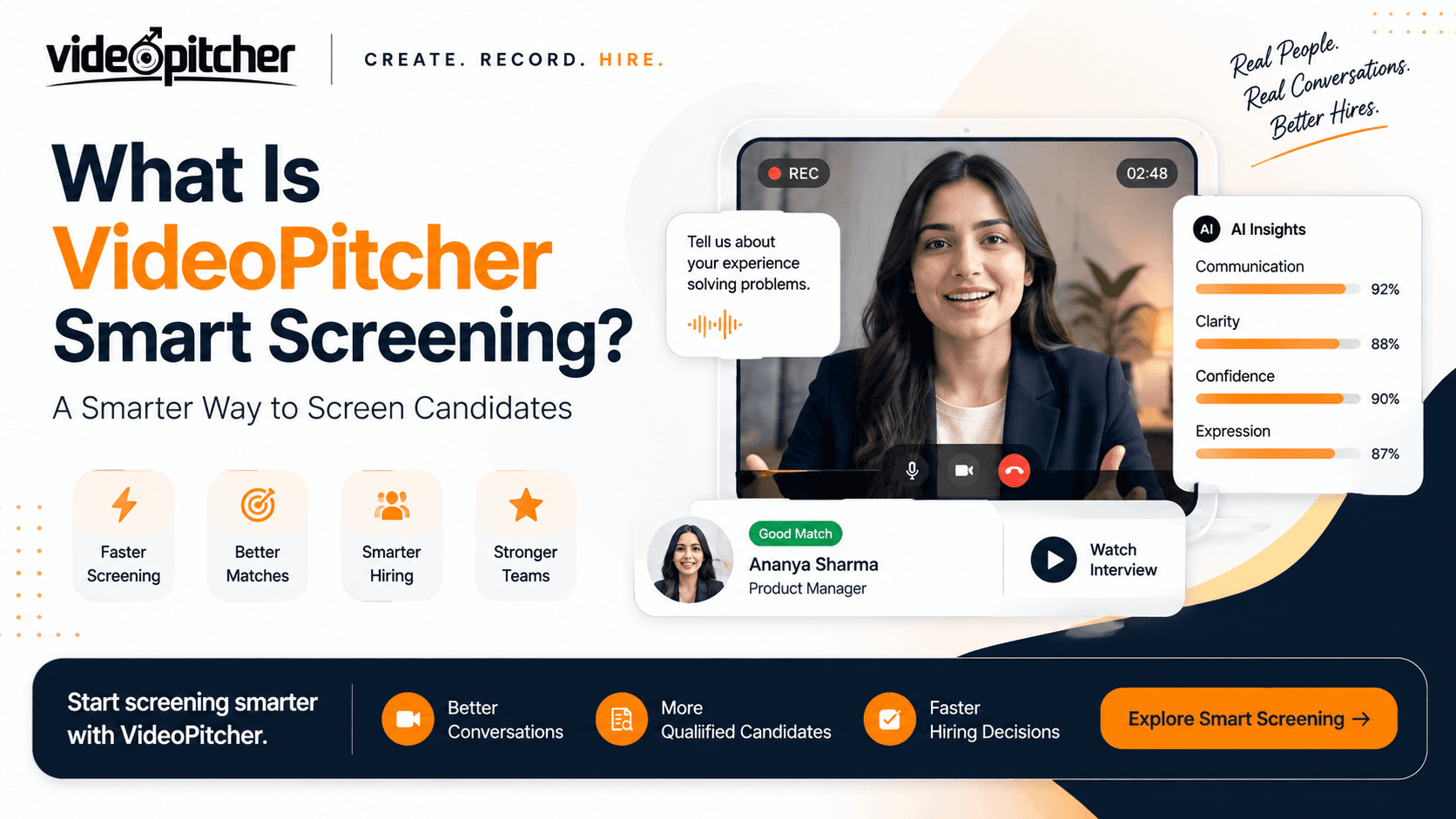
VideoPitcher was built specifically to address the 'middle-funnel' bottleneck of remote recruitment. Unlike enterprise suites that are bloated and expensive, VideoPitcher focuses on simplicity and affordability. Recruiters can create a session in minutes, choose between text and video response types, and generate public or private links to share across job boards or email campaigns. Its CDN-backed infrastructure ensures that candidates anywhere in the world can upload high-quality videos without the frustration of buffering or failed attempts. To understand cost impact, map this against your pricing and ROI model.
The real magic of VideoPitcher lies in its admin dashboard. All candidate submissions—including their text answers, video recordings, and contact details—are organized in a clean, searchable interface. Multi-user access allows your entire hiring team to rate and comment on candidates for free, fostering the collaborative review environment discussed earlier. With pricing starting at just ₹25 per assessment and 20 free credits for every new user, it makes professional-grade screening accessible to teams of all sizes.
Case Studies: Real-World Success with Remote Video Screening
Let's look at a hypothetical (but highly common) scenario: 'GrowthSync,' a Series A fintech startup. GrowthSync was scaling their customer success team and received over 400 applications for 5 open roles. Their two-person HR team was overwhelmed, spending all their time on initial phone screens that mostly went nowhere. They implemented an asynchronous video assessment using VideoPitcher, asking 3 situational questions focused on empathy and technical troubleshooting.
The result was transformative. Of the 400 applicants, 120 completed the assessment. The HR team spent just one afternoon reviewing these 120 submissions—about 6 hours of work. From those, they identified 15 'standout' candidates who were immediately moved to final-round interviews with the CEO. They filled all 5 roles in just three weeks, saving an estimated 100+ hours of manual phone screening time. More importantly, the new hires were of a higher caliber because the team had evaluated personality and problem-solving early in the process.
In another example, a global design agency used video interviews to screen for 'cultural alignment' among freelancers scattered across four time zones. By asking candidates to 'Show us your favorite project and explain why you're proud of it' via video, the agency was able to see the candidate's passion and communication style in a way that a static portfolio simply couldn't convey. This led to a 40% improvement in freak-out-free delivery because the agency knew exactly how each freelancer communicated before they ever started on a project.
Scorecard — implementation checklist
- Define clear competencies and success criteria for each remote role
- Design 3-5 high-signal questions (Behavioral, Situational, and Technical)
- Set up your assessment session on a dedicated platform like VideoPitcher
- Choose between public links for high-volume sourcing and private links for referrals
- Inform candidates about the video interview process early to manage expectations
- Review submissions using a standardized 1-5 rating scale to ensure fairness
- Enable collaborative review to get multiple perspectives on each candidate
- Watch video responses at 1.5x speed to maximize your screening efficiency
- Track metrics like completion rate and time-to-hire to continuously improve
- Sign up for VideoPitcher and claim your 20 free credits to get started today
Frequently asked questions
How do I ensure my video interviews are free from bias?+
Minimize bias by using a structured interview format where every candidate answers the same questions. Use a predefined scoring rubric and focus on job-related competencies. Encouraging multiple team members to review the same video can also help neutralize individual unconscious biases.
What is the ideal length for a video interview response?+
For initial screening, 60 to 90 seconds per question is ideal. This is long enough for a candidate to provide a meaningful answer but short enough for reviewers to evaluate quickly. VideoPitcher allows you to set specific time limits for each response.
Are asynchronous video interviews bad for candidate experience?+
On the contrary, most candidates appreciate the flexibility. Async interviews allow them to 'apply' at their own pace and balance recruitment with their current commitments. The key is to keep the assessment short (under 15 minutes) and the platform easy to use.
Can video interviews replace the final live interview?+
Generally, no. Video interviews are a screening tool designed to filter out the 'noise' and identify the top 10-20% of your talent pool. The final round should still be a live, interactive conversation to dive deep into specifics and finalize the hiring decision.
How do I deal with candidates who are shy on camera?+
Remind candidates that the goal is to assess their answers and communication style, not their 'acting' skills. Providing a 'practice' question or allowing them to re-record their responses can significantly lower anxiety and help you see their true potential.
Written by VideoPitcher Team
Recruitment Product & Research
The VideoPitcher team writes about hiring workflows, candidate assessment, and what we learn building the product.
Published February 2, 2026
Keywords covered
Related resources
Ready to transform your hiring process?
Start using VideoPitcher today with 20 FREE AI Video Screening Credits, plus Unlimited AI Resume Analysis and Unlimited Text Screening Assessments. No credit card is required—just start screening smarter and find the right candidates faster.